

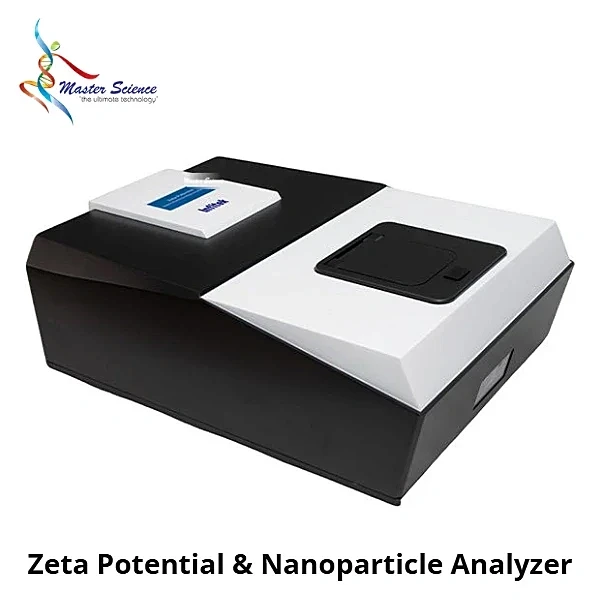
Zeta Potential Analyzer - Nanoparticle Size Analyzer - 0.3-10000 nm - ±500 mV
Inhouse product
The Master Science Zeta Potential Analyzer combines dynamic light scattering particle sizing and electrophoretic zeta potential measurement in a single compact instrument. It sizes nanoemulsions, colloids and suspensions from 0.3 nm to 10 µm and reports surface charge from -500 to +500 mV.
A high-speed digital correlator, sensitive photomultiplier detection and Peltier temperature control to ±0.1 °C give stable, repeatable data for formulation development and production QC.
Technical Specifications
Specifications of the Master Science Zeta Potential Analyzer:
- Brand: Master Science
- Model Number: MSPSA-LS901SWISS
- SKU: MSPSA-LS901SWISS
- Size Range: 0.3 to 10,000 nm (sample dependent)
- Zeta Potential Range: -500 to +500 mV
- Concentration Range: 0.1 to 100 mg/mL (sample dependent)
- Electrophoretic Mobility: > ±20 µm·cm/(V·s)
- Maximum Conductivity: 200 mS/cm (sample dependent)
- Size Accuracy / Repeatability: < 1 % (standard sample D50)
- Zeta Accuracy / Repeatability: < 15 % (standard sample)
- Laser: Semiconductor, 635 nm, 1 to 40 mW adjustable
- Detector: Photomultiplier tube
- Scattering Angles: 90° (size); 18° (zeta)
- Sample Cells: 10 × 10 × 40 mm, 1 to 4 mL (size); 10 × 10 × 60 mm, 1 mL (zeta)
- Temperature Range: 5 to 90 °C
- Temperature Accuracy: ±0.1 °C
- Test Time: < 5 min
- Correlator: 892 autocorrelation channels; 1 µs to 10 ms delay
- Dimensions: 600 × 420 × 210 mm
- Net Weight: 28 kg
Key Benefits
- Size and charge in one bench: the Master Science Zeta Potential Analyzer measures both stability indicators without moving the sample to another instrument.
- Clean photon signal: photomultiplier tubes give high sensitivity and signal-to-noise for weak scatterers.
- Temperature-stable data: ±0.1 °C control prevents viscosity and Brownian motion errors.
- Robust optics: fibre coupling and optical frequency shifting resist interference.
- Fast answers: results are ready in under five minutes.
For larger particles up to 3500 µm, see the Master Science laser particle size analyzer.
Product Features
Measurement
- Dynamic light scattering particle sizing
- Electrophoretic light scattering for zeta potential
- High-speed digital correlator
Detection and Optics
- Photomultiplier detection
- Fibre-coupled optical path
- Optical frequency shifting
Sample Handling
- Peltier temperature control 5 to 90 °C
- Separate cells for size and zeta
- Small sample volumes from 1 mL
Applications
The Master Science Zeta Potential Analyzer is used for:
- Nanomaterial research and fine chemicals
- Emulsions and pharmaceutical formulations
- Surfactants, polymers and oligomers
- Inks, pigments and coatings
- Colloid stability studies in universities
Common Laboratory Problems and How This Analyzer Helps
How the Master Science Zeta Potential Analyzer helps with nanoparticle characterisation:
- Formulations separating on storage: zeta potential predicts dispersion stability early.
- Temperature-driven size errors: precise Peltier control keeps conditions constant.
- Weak signals from small particles: PMT detection improves sensitivity.
- Two instruments for size and charge: one unit measures both.
- Long test times: results are available within minutes.
Frequently Bought Products
"Explore Master Science, your trusted provider of high-quality laboratory equipment and innovative solutions. Discover our extensive range of analytical instruments and exceptional customer support, all dedicated to empowering scientific discovery across industries. Join us in advancing research and setting new standards globally."